Best Sales Commission Software in 2026: 8 Platforms Compared
An in-depth, research-backed comparison of the 8 best sales commission software platforms in 2026 - pricing, strengths, weaknesses, and who each is really for.
Last updated: June 8, 2026.
Choosing sales commission software is one of those decisions that looks simple from a distance and gets complicated the moment you start comparing real platforms. (You’ll see the same category sold as sales compensation software or incentive compensation management (ICM) - different labels, same job.) Implementation timelines range from two weeks to nine months. And every vendor claims to be the easiest, most flexible, and most accurate option on the market.
If your priority is tracking performance against targets rather than just paying commission, see our companion guides on sales performance tracking software and sales target tracking.
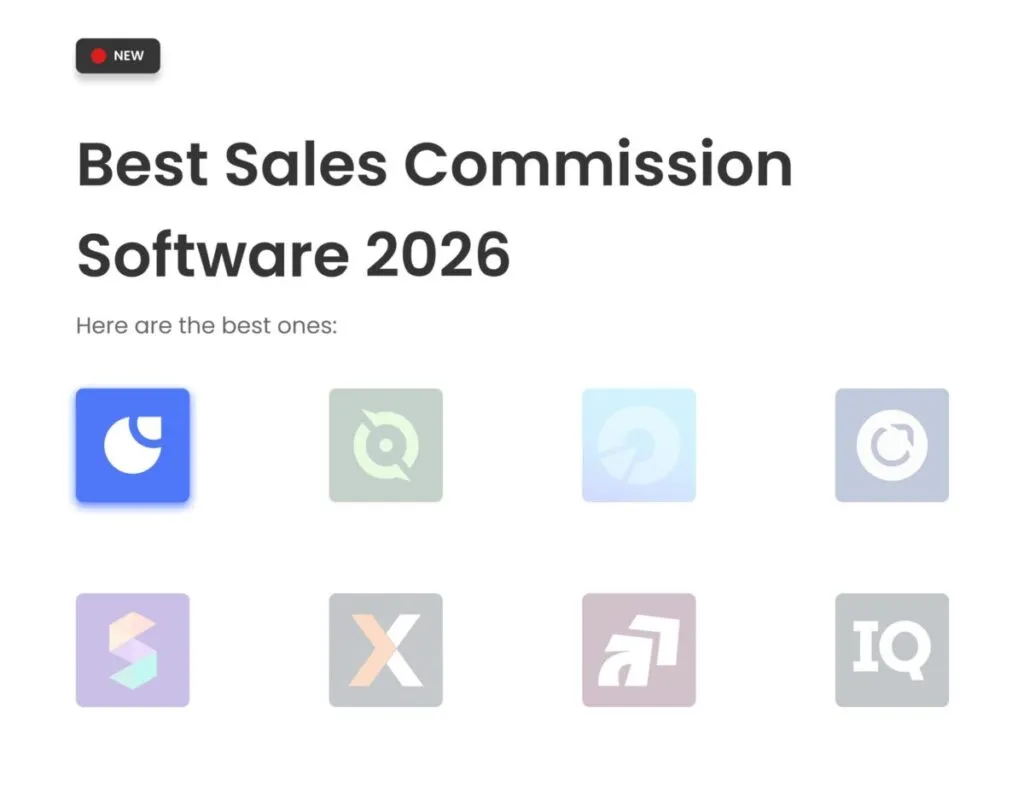
This guide cuts through that. We compared the eight most widely evaluated sales commission platforms in 2026 - Centify, CaptivateIQ, Xactly, Salesforce Spiff, Performio, Everstage, QuotaPath, and Qobra - using public pricing, vendor documentation, and aggregated reviews from G2, Capterra, and procurement data sources. For head-to-head pages on specific vendors, browse our alternatives hub - including Xactly, Salesforce Spiff, and CaptivateIQ. For each tool you’ll find honest strengths, real limitations, pricing reality, and the type of team it actually fits.
TL;DR: If you’re a European or SaaS company moving off spreadsheets and you want no-code automation, EU data residency, and fast implementation, Centify is usually the best fit. CaptivateIQ and Xactly lead for complex enterprise modeling. Salesforce Spiff is the natural choice for Salesforce-native teams. QuotaPath and Qobra are excellent value for mid-market teams that want transparent pricing and a clean rep experience.
How We Compared These Platforms
A commission tool is only “best” relative to your team’s size, plan complexity, and compliance requirements. We evaluated every platform against the dimensions that actually drive buying decisions:
- Pricing transparency and total cost - published rates vs. custom quotes, plus implementation and add-on fees.
- Plan complexity - how well each handles accelerators, tiers, splits, clawbacks, draws, and SPIFs.
- Implementation time and effort - how long to first accurate payout, and how much internal lift it takes.
- Ease of use - no-code configuration vs. admin-heavy setup, and the rep-facing experience.
- Compliance and data residency - GDPR, EU hosting, ASC 606, SOC 2, ISO 27001.
- Reviewer sentiment - recurring praise and complaints across G2, Capterra, and TrustRadius.
Pricing and ratings below reflect publicly available data as of early 2026. Vendors that quote custom pricing are noted as such, and figures are drawn from procurement intelligence (e.g. Vendr) and marketplace listings. Always confirm current pricing directly.
Quick Comparison: Leading Platforms at a Glance
| Platform | Best for | Starting price | Pricing model | Implementation | Hosting / compliance |
|---|---|---|---|---|---|
| Centify | European & SaaS teams moving off Excel | ~39/user/mo | Published, per user | 2–4 weeks (consulting included) | EU (Frankfurt), GDPR |
| CaptivateIQ | Complex mid-market & enterprise modeling | Custom (~$35K median ACV) | Custom, per payee | 8–12 weeks | US-centric, SOC 2 |
| Xactly | Large global enterprises | Custom (~$40–60/user/mo) | Custom, per user + modules | 8–16+ weeks | Enterprise, ASC 606, IFRS 15 |
| Salesforce Spiff | Salesforce-native revenue teams | $75/user/mo | Published, per user | Medium | Salesforce ecosystem |
| Performio | Enterprises with 70+ payees & high volume | Custom (~$50/user/mo) | Custom, per user | Months | Enterprise, audit-grade |
| Everstage | High-growth mid-market | Custom (~$41K median ACV) | Custom, per payee | Weeks (vendor-assisted) | Enterprise |
| QuotaPath | SMB to mid-market, transparent budgets | $25–50/user/mo + platform fee | Published, tiered | 2–6 weeks | SOC 2 |
| Qobra | European mid-market teams | ~€39/user/mo | Mostly custom | Fast (days to weeks) | EU-based |
The 8 Best Sales Commission Platforms, Reviewed
1. Centify - Best for European SaaS & No-Code Automation
For European and SaaS teams moving off spreadsheets, Centify is usually the best sales commission software in 2026: it’s the only platform on this list that pairs a no-code plan builder with EU data residency, GDPR-native security, published pricing, and a 2–4 week go-live with consulting included.
Centify was designed as a modern replacement for Excel without introducing technical complexity. Its no-code rule engine lets RevOps and finance teams build tiers, accelerators, draws, clawbacks, multi-product logic, and SPIFs directly - no engineering tickets required. Where it stands apart from most of this list is compliance: data is hosted on ISO-certified servers in Frankfurt, Germany, with full GDPR alignment, which matters enormously for European and DACH organizations.
The platform also publishes its pricing (a rarity in this category) and includes consulting support for setup, migration, and a parallel run before your first automated payout - so the typical go-live is 2–4 weeks, not months.
- Pricing: From ~39/user/month on an annual contract, with a 7-day free trial.
- Strengths: No-code plan builder, EU data residency and GDPR-native design, transparent pricing, fast implementation with hands-on consulting, real-time rep dashboards with “what-if” modeling, native Salesforce/HubSpot/ERP sync.
- Limitations: Smaller review footprint than incumbents like CaptivateIQ; less suited to organizations specifically seeking a US-hosted, enterprise-scale legacy platform with thousands of payees.
- Best for: SaaS companies, scaleups, and RevOps teams - especially in Europe - that want automation and compliance without admin overhead.
If you’re still wrestling with spreadsheets, our guide on moving from Excel to commission automation walks through the transition step by step.
2. CaptivateIQ - Best for Complex Modeling
CaptivateIQ is consistently among the highest-rated platforms in the category (roughly 4.7/5 on G2 across 1,700+ reviews) and is best known for its spreadsheet-like flexibility. Its modeling engine handles overlay crediting, hybrid roles, and multi-step workflows that break simpler tools, which is why it’s popular with mid-market and enterprise SaaS companies running intricate plans. In 2026 the company is also rolling out AI agents for plan building and operations.
That power comes with overhead. Pricing is custom and per-payee - procurement data puts the median annual contract around $35,000, with small teams typically $20K–$50K, mid-market $50K–$150K, and enterprise deployments running well past $150K once implementation and the integration platform are included.
- Pricing: Custom quote, per payee; ~$660/seat/year base before volume discounts, plus integration and implementation fees.
- Strengths: Best-in-class plan flexibility, strong governance, deep CRM/ERP/data-warehouse integrations, large customer base (Figma, Gong, Affirm).
- Limitations: 8–12 week implementations that require real internal lift, out-of-the-box reporting that often needs customization, and per-payee pricing that’s hard to justify under ~30 reps.
- Best for: Mid-market and enterprise teams with complex plans and the RevOps resources to support setup.
3. Xactly - Best for Enterprise Scale & Compliance
Xactly is the most established enterprise incentive compensation platform, built for hundreds or thousands of payees, multi-currency hierarchies, and strict regulatory requirements. Its differentiators are 20+ years of benchmarking data (Xactly Insights), ASC 606 and IFRS 15 compliance, and reliability at enormous scale. It’s sold in tiers - Incent Core, Plus, and Ultimate.
The trade-offs are familiar for legacy enterprise software: higher cost, longer implementations (often 3–9 months), a UI that reviewers describe as dated in parts, and slower product innovation than newer entrants. Its G2 rating (~4.2–4.3/5) sits below the newer platforms, largely on usability and support consistency.
- Pricing: Custom; estimated ~$40–60/user/month for core modules, with implementation fees of $15K–$150K+.
- Strengths: Enterprise scalability, industry-leading benchmarking, strong compliance and audit trails, mature Salesforce integration.
- Limitations: Expensive total cost of ownership, complex implementation, dated admin experience, variable support response times.
- Best for: Large global enterprises that prioritize compliance, benchmarking, and scale over speed and simplicity.
4. Salesforce Spiff - Best for Salesforce-Native Teams
Spiff (acquired by Salesforce in 2024 and now sold as Salesforce Incentive Compensation Management) focuses on real-time commission visibility and a polished rep experience. Its tight Salesforce integration makes it a natural fit for Salesforce-first revenue teams, and its no-code Designer handles complex accelerator and override structures.
Notably, Spiff publishes its price: $75/user/month, billed annually. Watch the add-ons, though - each non-Salesforce data connector runs $250/month, and premium support is priced at 30% of net license cost. Reviewers (4.5/5 on G2) love the rep dashboards but note that initial configuration takes careful RevOps attention, and some report slower support responsiveness post-acquisition.
- Pricing: $75/user/month (published); $250/month per non-Salesforce connector; premium support at 30% of net.
- Strengths: Excellent rep-facing transparency, deep Salesforce integration, no-code plan design, Salesforce’s long-term backing.
- Limitations: Salesforce-first (less ideal for other CRMs), implementation complexity for intricate plans, connector and support costs add up.
- Best for: Mid-market and enterprise teams already standardized on Salesforce.
5. Performio - Best for Audit, Compliance & High Volume
Performio targets organizations with 70+ commissionable employees and complex, high-volume plans - it advertises support for 20,000+ payees per processing cycle and multi-currency FX handling. Its configurable, no-code engine pairs with strong audit and compliance capabilities, and it bundles 24/7 support, training, and an upfront (rather than open-ended) implementation cost.
Its weak spots, reflected across ~940 G2 reviews (4.4/5), are an interface that feels dated, slow page loads with large datasets, occasional sync delays, and reporting that hits limits for specialized needs.
- Pricing: Custom quote; ~$50/user/month, with mid-market contracts roughly $30K–$120K and enterprise often $200K+.
- Strengths: Highly configurable plan engine, audit-ready logic, scales to very large payee populations, predictable (non-usage-based) pricing.
- Limitations: Dated UI and slower performance, reporting customization limits, more than smaller teams need.
- Best for: Mid-market and enterprise teams with complex, high-volume commission workflows.
6. Everstage - Best for High-Growth Mid-Market
Everstage has the highest review sentiment in the category (4.8/5 on G2 across 2,000+ reviews) and a 97% recommendation rate in Gartner’s Customers’ Choice survey. Reviewers praise its ease of use, real-time tracking, accuracy, and intuitive dashboards. It increasingly positions itself as a broader platform spanning incentives, CPQ, and planning.
Pricing is opaque - procurement data shows a median around $41,000/year (observed range ~$28K–$107K). And the 4.8 rating isn’t the whole story: 46 reviewers flag a real learning curve, and sync delays and occasional slow performance show up consistently enough to plan around.
- Pricing: Custom quote, per payee; median ~$41,140/year.
- Strengths: Top-rated ease of use, strong real-time visibility, flexible plan modeling, broadening platform scope.
- Limitations: No public pricing, learning curve for complex plans, reported sync delays and navigation friction; overkill below ~30 payees.
- Best for: High-growth mid-market companies that want a flexible, well-liked platform and can negotiate pricing.
7. QuotaPath - Best for Transparent, Mid-Market Budgets
QuotaPath wins on transparency and time-to-value. Its pricing is fully published and tiered - Essential at ~$25/user/month, Growth at ~$35, and Premium at ~$50, each with a monthly platform fee ($525–$800) that covers the first five users plus setup and support. Implementation is fast (2–6 weeks), and reviewers (4.7/5 on G2) consistently highlight the clean UI, easy onboarding, and frequent updates that address feedback.
It’s intentionally lighter than the enterprise tools: highly complex, multi-entity structures and very large datasets are where teams report it strains, and some want faster live support.
- Pricing: $25–$50/user/month + $525–$800/month platform fee (published); free trial available.
- Strengths: Transparent pricing, clean UX, fast setup, strong Salesforce/HubSpot integrations, ASC 606 support on higher tiers.
- Limitations: Less suited to enterprise-grade complexity, performance with very large datasets, support speed.
- Best for: SMB to mid-market teams with straightforward, CRM-integrated plans and a need for budget predictability.
8. Qobra - Best European Mid-Market Alternative
Qobra is a France-based platform serving 30,000+ users, with an intuitive no-code interface, multi-currency support, and real-time dashboards that reps genuinely like. Customers cite very fast plan changes (some implementing a full new plan year in a single day) and strong support. Starting pricing is published at roughly €39/user/month, with enterprise quoted custom.
Reviewers note the same caveats as most mid-market tools: a learning curve when plans get very complex, occasional update delays, and a desire for deeper customization, smoother mobile, and broader integrations.
- Pricing: From ~€39/user/month (custom for enterprise); free trial available.
- Strengths: Intuitive UI, multi-currency, fast plan changes, responsive support, strong rep transparency, EU-based.
- Limitations: Customization and integration depth for very complex plans, mobile ergonomics, occasional sync delays.
- Best for: European mid-market teams wanting a modern, easy-to-use platform.
Pricing Comparison: What You’ll Actually Pay
Sticker price rarely tells the full story in this category. Two patterns matter most:
Published vs. custom pricing. Centify, Salesforce Spiff, and QuotaPath publish per-user rates, which makes budgeting straightforward. CaptivateIQ, Xactly, Performio, and Everstage require custom quotes, so expect a demo before you see a number - and expect the number to scale with payee count and plan complexity.
Hidden costs. The per-seat rate is rarely the total. Watch for:
- Implementation fees - $5K–$150K+ on the enterprise platforms (CaptivateIQ, Xactly, Performio), often quoted as a percentage of contract value.
- Integration/connector fees - e.g. Spiff’s $250/month per non-Salesforce connector, or CaptivateIQ’s separately priced integration platform.
- Support tiers - e.g. Spiff’s premium support at 30% of net license.
- Minimum contract sizes - per-payee platforms often have floors that make them uneconomical under ~30 reps.
For a 30-person team, the practical first-year spend ranges from roughly €18K–€30K on transparent platforms like Centify or QuotaPath to $25K–$45K+ on CaptivateIQ once implementation and add-ons are included - and considerably more on Xactly or Performio. If you’re weighing the build-it-yourself route instead, our make vs. buy analysis covers the true cost of spreadsheets.
Why Automate? The Problems Commission Software Solves
Every platform on this list exists to fix the same set of spreadsheet failures. If any of these sound familiar, it’s a signal you’ve outgrown manual processes.
Eliminating errors and disputes
When commissions live in spreadsheets or disconnected systems, mistakes are inevitable - a deleted row, a broken formula, an out-of-date rate. Those errors erode trust between sales and finance, trigger time-consuming investigations, and hurt morale. Automated software applies consistent logic and keeps a clear, auditable record of every calculation. (See our deep dive on calculating sales commissions accurately.)
Reducing manual maintenance
Spreadsheet-based systems demand constant updates, formula checks, and version control. As plans grow more complex, that maintenance becomes fragile and all-consuming. Commission software replaces it with automated workflows, freeing RevOps and finance to focus on strategy instead of upkeep. Our guide to commission automation breaks down what that shift looks like in practice.
Accelerating payouts
Manual calculations slow down approvals and reporting, delaying payments and demotivating reps. Automated systems calculate in real time or on a set schedule, ensuring faster, more reliable payouts.
Increasing transparency and scalability
When reps can’t see how their commission is calculated, uncertainty and frustration follow. Clear dashboards let reps track earnings, understand performance, and trust the process. Just as importantly, automated platforms scale as roles, territories, products, and incentive models multiply - something spreadsheets simply can’t do gracefully.
How to Choose the Right Sales Commission Software
The best platform depends less on feature checklists and more on who you are. Start with these five questions:
- Are we still calculating commissions in Excel?
- Do we need GDPR-compliant, EU-hosted data?
- How often do our commission rules change?
- Do we need RevOps + Finance + Sales alignment?
- Do we want self-serve (no-code) logic or an admin-heavy system?
Then match your profile to the right tool:
- European or SaaS team leaving spreadsheets, wants no-code + compliance + speed → Centify
- Complex enterprise plans, dedicated RevOps team → CaptivateIQ
- Large global enterprise, compliance and benchmarking first → Xactly
- Standardized on Salesforce → Salesforce Spiff
- High volume, audit-heavy, 70+ payees → Performio
- High-growth mid-market, wants top-rated usability → Everstage
- Wants transparent pricing and fast setup → QuotaPath
- European mid-market, modern and easy → Qobra or Centify
The verdict: If you answer “yes” to questions 1–4 and want no-code logic, Centify is usually the strongest fit. Organizations with highly complex modeling and large technical teams often land on CaptivateIQ or Xactly, while Salesforce-native teams lean toward Spiff.
Switching From Spreadsheets (or Another Platform)
Migration is the step most teams worry about - and it’s more manageable than it looks. Here’s what typically transfers and what needs attention:
- What transfers easily: Historical deal and payout data (via CSV or API), rep and team structures, and CRM-sourced records once integrations are connected.
- What needs reconfiguration: Commission logic has to be rebuilt as rules (tiers, accelerators, clawbacks, splits), and approval workflows need to be defined explicitly. This is actually a benefit - it forces you to formalize logic that was previously buried in formulas.
- What good vendors offer: A parallel run (calculating in the new system alongside your old process) to validate accuracy before the first live payout. Centify includes consulting and a parallel run in its 2–4 week onboarding; most enterprise platforms offer structured implementation services for a fee.
The biggest variable isn’t the software - it’s validating your data and codifying your rules. That’s where included consulting (rather than billable professional services) makes the difference for smaller teams.
Conclusion
There is no single “best” sales commission software - only the best fit for your size, complexity, and compliance needs. Companies that require GDPR compliance, European hosting, transparent pricing, and fast implementation consistently find Centify the strongest choice. Organizations with highly complex modeling and larger technical teams may prefer CaptivateIQ or Xactly. Salesforce-native teams gravitate to Spiff, while Performio suits high-volume, audit-heavy enterprises. For mid-market teams that value usability and predictable budgets, Everstage, QuotaPath, and Qobra are all excellent.
What they share is a clear path away from error-prone spreadsheets toward scalable, transparent, automated commission management - the foundation for turning commissions into a growth engine rather than a monthly fire drill.
FAQ – Sales Commission Software
What is sales commission software? A platform that automates commission calculations, payouts, reporting, and transparency - replacing manual spreadsheets with consistent, auditable logic.
Is sales compensation software the same as commission software? Yes. Sales compensation software, commission software, and incentive compensation management (ICM) all describe the same category - tools that calculate, approve, pay, and report on variable pay. The label varies by vendor and buyer, but the job is identical.
Is commission software better than Excel? Yes. Excel doesn’t scale, breaks easily, and lacks auditability. Automated tools reduce errors, accelerate payouts, and save hours of maintenance each month.
Which is the best commission software for European companies? Centify, thanks to its GDPR-native design, EU hosting in Frankfurt, ISO 27001 and SOC 2 certification, and local support. Qobra is another solid EU-based option.
Which is the best commission software for SaaS? Centify and CaptivateIQ both serve SaaS well. Centify is simpler to operate long-term and faster to implement; CaptivateIQ offers deeper modeling for very complex plans.
Which platforms publish their pricing? Centify (~ 39/user/month), Salesforce Spiff ($75/user/month), QuotaPath ($25–$50/user/month + platform fee), and Qobra (~€39/user/month) publish rates. CaptivateIQ, Xactly, Performio, and Everstage require custom quotes.
How long does implementation take? It ranges widely: 2–4 weeks for Centify (consulting included), 2–6 weeks for QuotaPath, 8–12 weeks for CaptivateIQ, and 3–9 months for enterprise Xactly deployments. Validating data and codifying rules is most of the work.