
What is a Sales Commission? Structures, Examples & Guide
TLDR
Sales commission is a variable payment paid to salespeople when they achieve predefined results (e.g., revenue, deals closed, margin). It aligns incentives with business goals and is typically calculated as a percentage or fixed amount on top of base salary.
What is a Sales Commission?
Sales commission is a performance-based compensation component that rewards sales employees for measurable outcomes such as revenue generated, contracts signed, or profit margin achieved. It ensures that compensation is directly linked to results rather than being entirely fixed.
This model creates a strong alignment between individual performance and company success. The more value a salesperson generates, the more they earn. As a result, sales commission is a core element of modern sales compensation plans and incentive compensation management (ICM).
Sales commission is used across industries, including SaaS, manufacturing, financial services, and retail. It provides companies with a scalable way to reward performance while maintaining financial efficiency.
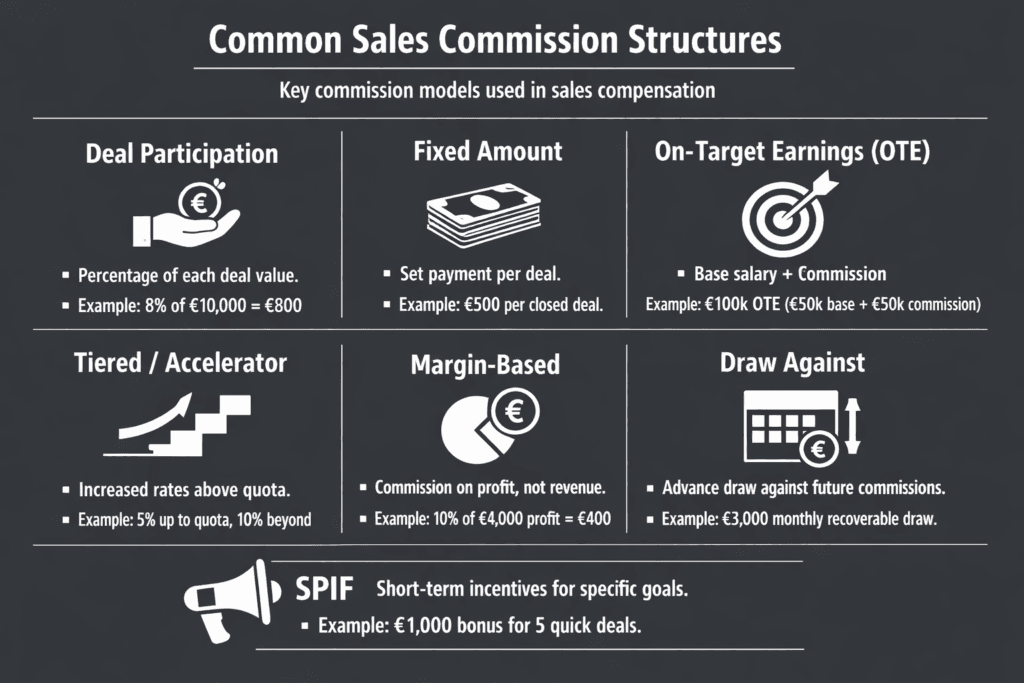
Common Sales Commission Structures
Sales commission structures define how earnings are calculated and how performance translates into compensation. Different structures are designed to incentivize specific behaviors, such as maximizing revenue, increasing deal volume, improving profitability, or encouraging overperformance.
Each structure serves a different strategic purpose depending on the company’s sales model, deal size, and growth objectives.
Deal participation
One of the most common sales commission structures is deal participation, where the salesperson earns a percentage of a defined base KPI from each closed deal. In most cases, this KPI is revenue, but it can also be annual recurring revenue (ARR), total contract value (TCV), or another clearly measurable financial outcome. For example, if a salesperson earns 8% commission and closes a deal worth €10,000 in revenue, they would receive €800 in sales commission. This creates a direct and transparent link between the value generated for the company and the salesperson’s earnings.
This structure is highly effective because it aligns incentives between the company and the salesperson. The salesperson is motivated to close more deals and, in many cases, larger deals, since their earnings increase proportionally with deal value. It also makes sales commission calculations simple, predictable, and easy to understand, which builds trust and clarity within the sales team. Salespeople can easily estimate their expected income based on their pipeline, and management can forecast commission expenses alongside revenue growth.
Deal participation works especially well in SaaS and other transactional sales environments where deal values are clearly defined and consistently tracked. In SaaS, the sales commission may be based on annual recurring revenue to emphasize long-term customer value rather than one-time payments. In industries such as solar panels or heat pumps, where each contract has a clear total value and standardized pricing components, percentage-based commission ensures fair and proportional compensation across deals of different sizes.
This structure also scales well as organizations grow. It can be applied uniformly across teams, regions, or products, and it integrates easily with quota systems and performance tracking. Companies can further refine the model by applying different percentages to different products, contract lengths, or strategic priorities. Overall, deal participation provides a simple, scalable, and performance-aligned sales commission model that directly rewards revenue generation.
Fixed amount
Another sales commission structure is a fixed amount per deal, where the salesperson earns a predefined payment for each contract they close, such as €500 per closed contract. Unlike percentage-based commission, the payout does not depend on the deal value. Whether the contract is worth €3,000 or €10,000, the sales commission remains the same. This makes the structure simple, transparent, and easy to administer, as both the company and the salesperson clearly understand the reward tied to each successful transaction.
This approach works particularly well for high-volume sales teams where deal sizes are relatively similar or where the business prioritizes the number of deals over the individual deal value. It encourages consistent activity and steady deal flow, since each closed contract contributes equally to the salesperson’s earnings. It also helps organizations control sales commission costs and maintain predictable unit economics, which is especially important in transactional or standardized sales environments.
From an SDR (Sales Development Representative) perspective, a fixed amount structure can be applied to earlier stages of the sales funnel rather than closed revenue. Since SDRs typically focus on outbound prospecting, qualifying leads, and booking meetings rather than closing deals themselves, their fixed commission is often tied to specific measurable outcomes. For example, an SDR might earn €50 for each qualified meeting that takes place, €100 for each sales-qualified opportunity created, or €200 for each opportunity that progresses to a later stage in the pipeline. In some organizations, SDRs may also receive a fixed bonus when an opportunity they sourced ultimately closes, aligning their incentives with overall revenue outcomes.
This model is particularly effective for SDR teams because it reinforces high activity levels, consistent pipeline generation, and focus on quality qualification. It also provides predictable and motivating rewards, especially for newer sales professionals who are still developing their closing skills. By linking fixed payments to clearly defined milestones, companies can ensure SDRs are incentivized to generate valuable opportunities while maintaining a simple and scalable compensation structure.
On-target-earnings (OTE)
On-target earnings, or OTE, is a core concept in sales compensation that defines the total expected annual earnings of a salesperson when they achieve 100% of their quota. OTE includes both the fixed base salary and the variable commission component. For example, if a salesperson has an OTE of €100,000 with a 50/50 split, this means they earn €50,000 as base salary and €50,000 in commission when they fully reach their quota. The base salary provides income stability, while the variable portion creates a strong performance incentive tied directly to results.
OTE serves as a clear reference point for both the company and the salesperson. It communicates how much a salesperson is expected to earn under normal, successful performance conditions. At the same time, it defines the performance expectations required to reach that income level. If a salesperson achieves less than 100% of their quota, their total earnings will typically be lower than the OTE. Conversely, if they exceed their quota, their total earnings can surpass the OTE, especially in plans that include accelerators or uncapped sales commission.
This structure helps align compensation with business outcomes by linking a meaningful portion of earnings to measurable performance. It ensures that salespeople are rewarded for achieving revenue targets while still providing a stable financial foundation through the base salary. It also helps companies attract and retain talent by presenting a transparent and competitive earning potential.
OTE is also widely used for SDRs, although the structure and ratios are typically different. SDR OTE often has a higher base salary component, such as a 70/30 or 80/20 split, reflecting their focus on pipeline generation rather than closing revenue. For example, an SDR might have an OTE of €60,000 consisting of €45,000 base salary and €15,000 variable compensation tied to qualified meetings, opportunities created, or pipeline generated. This ensures SDRs have stable income while still being incentivized to consistently produce high-quality pipeline that supports the overall sales organization.
Tiered / Accelerator
Tiered or accelerator commission structures are designed to reward salespeople not only for reaching their quota, but especially for exceeding it. In this model, the commission rate increases once specific performance thresholds are reached. For example, a salesperson might earn 5% commission on revenue up to 100% of their quota, and 10% commission on any revenue above that level. This means the salesperson earns a higher reward for each additional euro generated after hitting their target, which creates a strong financial incentive to continue selling beyond the minimum expectations.
Accelerators are typically applied on top of a deal participation model. This means the salesperson always earns a percentage of the revenue from each deal, but the exact percentage depends on their current quota attainment. For instance, if the standard deal participation rate is 5%, the salesperson earns 5% commission while they are below or at quota. Once they exceed quota, the commission rate increases, for example to 7%, 10%, or more. This ensures that high performers are rewarded disproportionately more for generating incremental revenue, reflecting the additional value they bring to the company.
Accelerators are closely tied to OTE, because the commission rate at 100% quota attainment is calibrated so that the salesperson earns their full variable portion of OTE at that point. For example, consider a salesperson with an OTE of €100,000, consisting of €50,000 base salary and €50,000 variable commission, and an annual quota of €1,000,000 in revenue. The commission rate up to quota might be set at 5%, which means that reaching €1,000,000 in revenue generates €50,000 in sales commission. Combined with the €50,000 base salary, the salesperson reaches their full €100,000 OTE.
Once the salesperson exceeds their quota, accelerator rates apply. For example, revenue above €1,000,000 might earn 10% commission instead of 5%. If the salesperson closes €1,200,000 in total revenue, they would earn €50,000 commission on the first €1,000,000 and €20,000 commission on the additional €200,000, resulting in €70,000 total commission. Combined with the €50,000 base salary, their total earnings would be €120,000, exceeding their original OTE. This demonstrates how OTE represents expected earnings at target performance, while accelerators create uncapped upside for exceeding targets.
This structure is particularly effective because it balances predictability and motivation. The standard deal participation rate ensures consistent rewards for achieving quota, while accelerator tiers create strong incentives for overperformance. It encourages salespeople not to slow down after reaching their targets and aligns their motivation with continued revenue growth for the business.
Margin-based
Margin-based commission focuses on the profitability of a deal rather than its total revenue. Instead of earning commission on the full contract value, the salesperson earns commission based on the gross profit the deal generates. Gross profit is calculated as the revenue from the deal minus the direct costs required to deliver the product or service. For example, if a deal generates €10,000 in revenue and the direct costs are €6,000, the gross profit is €4,000. If the commission rate is 10% of gross profit, the salesperson earns €400 in sales commission.
This structure ensures that salespeople are incentivized not just to close deals, but to close profitable deals. In revenue-based commission models, a salesperson may be motivated to offer heavy discounts in order to win business, even if it reduces profitability. Margin-based commission aligns the salesperson’s incentives with the company’s financial health by encouraging them to maintain strong pricing, avoid unnecessary discounting, and prioritize higher-margin products or services.
Margin-based commission is particularly common in services, manufacturing, and project-based industries, where delivery costs can vary significantly between deals. In these environments, two deals with the same revenue can generate very different levels of profit depending on factors such as production costs, customization, implementation effort, or negotiated pricing. By tying sales commission to gross profit, companies ensure that compensation reflects the true economic value of each deal rather than just its top-line revenue.
This model can also be combined with OTE and quota structures. For example, a salesperson might have a gross profit quota of €400,000 and a commission rate of 10% on gross profit. Achieving this quota would generate €40,000 in commission, which would represent the variable portion of their OTE. Accelerators can also be applied, increasing the commission rate once the gross profit quota is exceeded. This maintains consistency with other sales commission structures while reinforcing a strong focus on profitable growth.
Overall, margin-based sales commission creates strong alignment between sales behavior and business profitability. It encourages disciplined pricing, improves overall margins, and ensures that sales compensation reflects the real financial contribution of each deal.
Draw against
Draw against commission is a compensation structure where a salesperson receives an advance payment that is later offset against the sales commission they earn. This draw functions as a guaranteed minimum payment during a given period, usually monthly, and is intended to provide financial stability while the salesperson builds their pipeline and begins generating revenue. Once the salesperson starts earning sales commission, those earnings are used to repay the draw amount.
There are two main types of draw structures: recoverable draw and non-recoverable draw. In a recoverable draw, the advance must be paid back through future earned commission. For example, if a salesperson receives a monthly draw of €3,000 and earns €5,000 in commission that month, €3,000 is used to offset the draw and the salesperson receives the remaining €2,000. However, if they only earn €2,000 in commission, the remaining €1,000 may carry forward as a balance that must be offset by future commissions. In contrast, a non-recoverable draw acts more like a guaranteed minimum commission. If the salesperson earns less commission than the draw amount, they are not required to repay the difference. This approach provides more security but also carries more risk for the employer.
Draw structures are commonly used during ramp-up periods, especially for new hires who need time to build a pipeline before closing deals. Since sales cycles can take several months, new salespeople may not earn meaningful commission immediately. The draw ensures they have predictable income during this period while still maintaining a performance-based compensation model. As the salesperson ramps up and begins consistently earning commission, the draw is typically reduced or phased out entirely.
Draw against commission is usually integrated into an overall OTE structure. For example, a salesperson with a €100,000 OTE and €50,000 variable commission might receive a monthly recoverable draw of approximately €4,167, which represents the expected monthly commission at full quota attainment. As they close deals and earn commission through deal participation, those earnings offset the draw. Over time, the goal is for the salesperson’s actual earned commission to fully replace the draw.
This structure balances income stability and performance incentives. It reduces financial pressure during ramp-up, helps companies attract new talent into sales roles, and ensures that compensation remains aligned with actual sales performance once the salesperson is fully productive.
SPIF
SPIFs, or Sales Performance Incentive Funds, are short-term incentives designed to drive specific behaviors or accelerate performance in targeted areas. Unlike standard commission, which is part of the ongoing compensation plan, SPIFs are temporary and focused on achieving a defined objective within a limited timeframe. For example, a company might offer a €1,000 SPIF for closing five deals in a month, selling a newly launched product, or generating a certain number of qualified opportunities.
SPIFs are used to create urgency and focus. They help companies direct sales attention toward strategic priorities, such as promoting higher-margin products, boosting performance during slower periods, or supporting new product launches. Because SPIFs are time-bound and offer additional rewards on top of regular commission and OTE, they can significantly increase motivation and short-term activity.
SPIFs can be applied across different sales roles. For Account Executives, they may reward closed deals or revenue milestones, while for SDRs, they often reward qualified meetings booked, pipeline generated, or opportunities created. This makes SPIFs a flexible tool to influence behavior across the entire sales funnel.
Overall, SPIFs complement existing commission structures by providing targeted, short-term incentives that reinforce business priorities, accelerate results, and create additional earning opportunities beyond the standard compensation plan.
Why Sales Commission Matters
Sales commission plays a critical role in motivating sales performance by directly linking compensation to results. Unlike fixed salaries alone, commission creates a clear financial incentive for salespeople to close deals, generate revenue, and consistently perform at a high level. The more value they create for the company, the more they earn. This performance-based reward system encourages ownership, accountability, and sustained effort, especially in competitive sales environments where consistent activity and persistence are required to succeed.
Commission also aligns sales behavior with company goals by rewarding the outcomes that matter most to the business. For example, if a company wants to prioritize recurring revenue, commission can be tied to annual recurring revenue. If profitability is the focus, commission can be based on gross margin. If pipeline growth is critical, SDR commissions can be tied to qualified opportunities created. This alignment ensures that salespeople naturally focus their time and energy on activities that drive strategic business objectives, creating consistency between individual incentives and organizational success.
Another important benefit of sales commission is that it creates transparency and fairness in compensation. Clear commission structures define exactly how performance translates into earnings, which builds trust and reduces ambiguity. Salespeople understand what is expected of them and how their efforts will be rewarded. High performers are compensated proportionally to their contribution, which reinforces a performance-driven culture and helps retain top talent. At the same time, management can objectively measure performance using defined metrics such as revenue, profit, or quota attainment.
Sales commission also enables companies to scale revenue without proportionally increasing fixed costs. Because commission is variable and tied to actual results, compensation increases only when revenue increases. This makes sales compensation highly efficient from a financial perspective. Companies can invest in growing their sales teams with lower fixed salary risk, knowing that a significant portion of compensation is funded by the revenue those salespeople generate. This creates a scalable growth model where compensation and business performance grow together in a sustainable and aligned way.
Sales Commission vs Bonus (Quick Comparison)
Sales commission and bonuses are both forms of variable compensation, but they differ in how they are structured, triggered, and perceived by sales teams. Sales commission is typically tied directly to individual performance and is earned when a salesperson achieves a specific measurable outcome, such as closing a deal or generating revenue. In contrast, bonuses are often tied to broader goals, such as company performance, team achievements, or strategic milestones, and may not always depend solely on individual results.
Commission is usually paid more frequently, most commonly on a monthly or quarterly basis, and follows a clear, rule-based formula. This makes it predictable, transparent, and easy for salespeople to track and forecast. Bonuses, on the other hand, are often paid quarterly or annually and may be more discretionary. While some bonuses follow defined criteria, others depend on management decisions or overall business performance.
Commission structures are typically easier to automate because they rely on specific, measurable inputs such as revenue or deal count. Bonuses may involve more qualitative evaluation or multiple factors, making them somewhat less straightforward to standardize. Overall, commission is designed to directly incentivize ongoing sales activity, while bonuses are often used to reward broader performance, exceptional achievements, or strategic contributions.
Managing Sales Commission: Excel vs Software
Many companies still manage sales commissions in Excel, especially in early stages. While Excel is flexible and familiar, it often leads to errors, disputes, and inefficiencies as teams grow. Manual calculations increase the risk of mistakes, version control becomes difficult, and there is often no reliable audit trail to explain how payouts were calculated. Changes to commission plans require manual updates, and recalculations can be time-consuming. As the number of salespeople, deals, and commission rules increases, Excel becomes difficult to scale and maintain.
Modern sales commission management software solves these problems by automating calculations and ensuring accuracy. These tools automatically pull data from CRM systems, apply commission rules consistently, and generate clear payout reports. They also provide approval workflows, audit trails, and transparency for both sales teams and finance. This reduces administrative workload, prevents disputes, and ensures commissions are paid correctly and on time.
European SaaS companies and scaleups increasingly choose GDPR-native commission tools like Centify, which are designed specifically for complex and evolving sales organizations. These platforms offer no-code commission logic, allowing teams to define and update commission structures without relying on spreadsheets or engineering support. They also provide EU data residency and full GDPR compliance, which is critical for companies operating under European data protection regulations. In addition, built-in consulting and onboarding support help companies migrate from Excel and implement scalable, reliable commission processes that can grow with the business.
FAQs
Is sales commission taxable?
Yes. It’s treated as income and taxed accordingly (varies by country).
How often are commissions paid?
Typically monthly or quarterly, depending on plan design.
What’s a good commission rate?
Ranges from 5-50% depending on deal size, margin, and industry.
Can sales commission be automated?
Yes, with commission management software integrated with CRM/ERP.
What’s the difference between commission and OTE?
OTE (On-Target Earnings) = base salary + expected commission at quota.
Put your sales commissions on autopilot
Ditch the spreadsheets. Automate complex commission structures, ensure GDPR compliance, and motivate your sales team with real-time payout transparency.